Summary
1 No. The record shows that the effect is only temporary.
Introduction
2 It has recently been suggested that the problem of large scale immigration will resolve itself if, as expected, a recession occurs. This note examines the facts.
Recession
3 There have been three recessions in the past 38 years – 1975/6, 1981/2 and 1993. These show up clearly on the bar chart below, which plots the annual growth in GDP from 1970 to 2007.
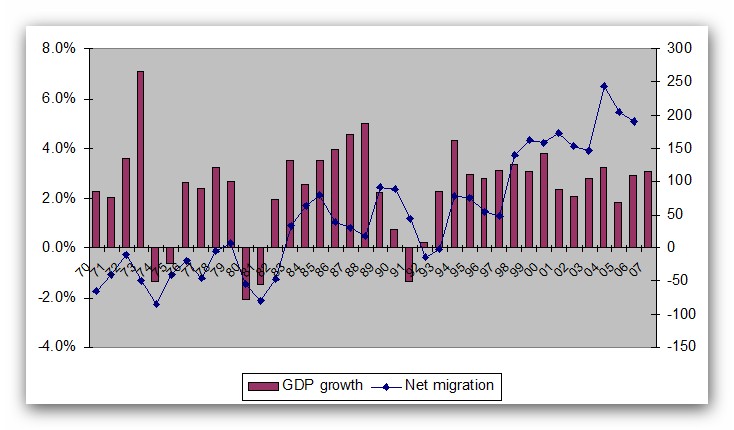
Source: GDP growth derived from ONS historical series ‘Real Gross Domestic Product, Chained Volume Measure (Series ABMI)’. Net migration from ONS.
Immigration
4 Net immigration (in thousands) is shown as a graph over the same period. It is clear that it has fluctuated about a strong upward trend for nearly three decades.
Conclusion
5 We conclude that the current downturn in the economy may also lead to a reduction in net international migration into the UK but, assuming the economy recovers, the reduction is likely to be short-lived unless action is taken to limit the number of migrants who are allowed to settle in the UK. A long term recession would be a very expensive way to control immigration.