
For years, politicians, officials, corporate lobbyists and many academics have insisted our nation’s prosperity depended on ever-escalating levels of mass migration. Migration Watch has argued against this and for years said that low-skill, low-pay immigration has been a colossal net cost to the exchequer. Here’s what we said 10 years ago in MW Briefing Paper 386 of 2016 where you will find the following table:
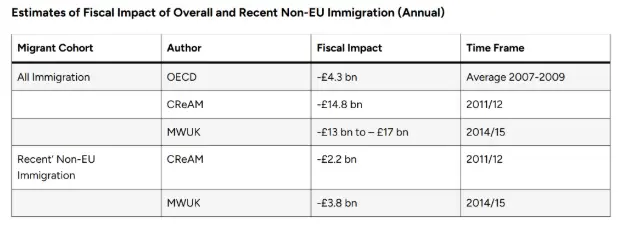
We have published other papers before and since (most recently just last week – the over-reliance on overseas workers – we wrote about it on these pages). Then, only this week, an excellent paper from the Centre for Social Justice (CSJ), State of Dependency, exposes the continuing reality of our broken economic model, and the high cost of high immigration. Between 2014 and late 2025, 3.7 million payrolled jobs were added to the UK economy, yet just 734,000 – barely one in five – went to British nationals, while 2.5 million went to non-EU workers. Turning Britain into a globalised economic zone is failing our people; passing over British workers for imported labour inflicts profound structural, fiscal, and social harm on the country.
At Migration Watch UK, we warned in 2020 that abolishing the Resident Labour Market Test (the “First Chance” rule requiring firms to advertise new roles in the UK first) and lowering skill and salary thresholds would expose 16 million UK jobs to uncapped worldwide competition. Stripping away that protection allowed employers to bypass British jobseekers entirely. As the CSJ reports, since 2020, payrolled jobs held by British citizens have fallen in nine out of 12 UK regions, even as non-EU employment surged everywhere.
Why does it matter so much when British workers are passed over? First, because an endless supply of overseas workers acts as a subsidy for big business, destroying the incentive to train our own youth or invest in productivity-boosting automation. The domestic skills ladder has been systematically dismantled: over a million young people in the UK are now considered NEETs, or “Not in Employment, Education or Training”. Because entry-level jobs in hospitality, retail, and social care are increasingly filled from abroad, disadvantaged young Britons are denied the vital first rung on the career ladder.
Second, sidelining domestic workers creates a devastating fiscal double-whammy for the British taxpayer. Today, 6.7 million people in Great Britain claim out-of-work benefits, and welfare spending over the last 20 years has exceeded infrastructure investment by over £1 trillion.
Simultaneously, importing low-wage labour drains the Exchequer. The Office for Budget Responsibility (OBR) estimates that a low-wage migrant arriving at age 25 is a net fiscal drain throughout their life, costing taxpayers £150,000 by state pension age and roughly £600,000 by the UK average life expectancy of 82. We are effectively paying twice: once to keep millions of working-age Britons idle on welfare, and again to subsidise the public services and infrastructure required for low-wage overseas workers.
Finally, this addiction to cheap labour suppresses wages and stagnates living standards. While immigration drove around 7 million of the UK’s 8 million population increase in the two decades after 2000, GDP per head barely budged after 2010.
Britain is a national home, and its Government has a duty and moral obligation to its citizens. We are not a borderless hiring hall. Our economy has become increasingly, and dangerously, dependent on immigrant labour. That didn’t happen accidently. The previous administration pursued this policy intentionally because employers, universities and NGOs told Boris Johnson’s administration it was necessary. It was not, and the British people are now paying the price. We must end this madcap, headlong rush towards national hara-kiri. There are a number of measures we must introduce, but mainly restore: cap visa numbers; restore the First Chance rule, prioritising British workers and offering jobs to them before employers considering recruiting from overseas; and compel employers to invest in the British workforce. The Home Office must also take back responsibility for vetting work-visa applicants before they arrive at the UK border. This means bringing back overseas-based visa officers. In the long run these measures would save the British taxpayer billions.