Migration Watch UK

Updated 12 May, 2014
NB Please see an updated briefing on the topics discussed in this paper by clicking this link: 'The History of Immigration to the UK'
1. Introduction
1.1 There have always been episodes of migration to Britain but, as this paper demonstrates, those episodes were small and demographically insignificant until the Second World War. A study of official census records from 1851 until the present shows that the number of people born abroad living in Britain was very small until the middle of the twentieth century and that the growth of this population between censuses was quite slow. Indeed, in the eighty years between 1851 and 1931, the population born abroad increased by only about one million. It increased slowly after the Second World War, growing by less than two million in the forty years between 1951 and 1991. In the late 1990s the pace and scale of migration increased to a level without historical precedent. Indeed the foreign born population of England and Wales more than doubled, increasing by nearly four million in the twenty years between the 1991 and 2011 censuses. It has now reached 13.4% of our population. This massive increase dwarfs the scale of any previous inflow in our history.
2. Measuring historic immigration
2.1. The Census began to record people’s country of birth from 1851.[1] Estimating the size of the foreign born population before that is much more difficult, but historical records give us some idea as to the scale of immigration before the mid-19th century. It was not until 1964 that the international passenger survey was established; it provides a broad picture of those entering and leaving the country on an annual basis.[2] In 1991 a more sophisticated measurement of immigration called the Long Term International Migration estimates was put in place.[3]
{related}3. Immigration before the first census
3.1. It has been asserted that 'the basic human stock of England has been settled and relatively homogenous since time immemorial’[4] but there have always been some movements of people to (and from) Britain. Defining the first occurrence of immigration to the British Isles is difficult and a point of controversy. It is important to note that, although we can estimate the size of the population and of migrations to Britain before records began, we cannot be precise about a period before documentary records survive.[5] Though it was almost certainly inhabited in a previous period, the area that is today Britain was uninhabitable during the ice age, with the oldest settled populations only migrating here after the end of the glacial period some 25,000 years ago. The period that followed until the Roman invasion is known as pre-history due to the lack of written records and as such little is known of the people that settled during that period. There is some controversy however as to whether the advent of agriculture in Britain 10,000 years ago was the result of cultural diffusion or the migration of peoples. In the first millennium AD, Britain experienced considerable inward flows of people although estimates of invaders and settlers are still uncertain.
4. The Roman period
4.1. It is widely accepted that, during the Roman occupation, the population of Britain was as large as it was during the Middle Ages,[6] and, although estimates vary, most would accept a figure of 4-5 million.[7] There is some evidence of migration to Roman Britain from other parts of the Empire, but there is considerable evidence to suggest that ‘the population of Roman Britain remained overwhelmingly indigenous.’[8] Indeed, while the Roman invasion force consisted of ‘45,000 men’[9] the garrison that was left in its place was usually smaller-falling from a peak of about 55,000 in the first century to a low of about 10,000-20,000 in the fourth century.[10] The administration of the country was left largely to the British, with one historian describing a ‘relatively small number of Roman officials’ with most of the ‘day to day work entrusted to the Romanized British.’[11] Including the Army’s dependants, there were probably 125,000 migrants[12] in the British Isles out of a population of 4 million, about 3%.
5. Anglo Saxons ,Vikings and Normans
5.1. The population of Britain declined markedly after the end of the Roman occupation, perhaps falling to as low as one and quarter million.[13] In the period of upheaval that followed the end of the Roman Empire, England experienced invasions and settlement by Germanic tribes such as the Jutes, Angles and Saxons.[14] The size and scale of the migrations that followed is a matter of historical debate. While the culture of the Anglo Saxons had become predominant in England a few centuries later and there is no doubt that a migration of Anglo-Saxons took place, the size and scale of it is disputed. Some historians advance a model in which only relatively small numbers of Germanic settlers came to England[15] but in which the people became Germanic through a process of acculturation compounded by the fact that those in positions of authority were Anglo-Saxon. Others argue that there was a large scale migration of Germanic people to Britain.[16] Most Historians have veered toward the minimalist model.[17] It is widely accepted that inflows from the subsequent Viking and Norman invasions were much smaller and less demographically significant. It has been estimated that the inflows from Viking invasions may have made up as much as 4-8% of the total population. Despite the huge significance of the Norman conquest of 1066, the numbers of Normans that followed William the Conqueror to England are accepted by most historians as being small. Indeed, one historian states that ‘only ten thousand or so Frenchmen followed in William’s footsteps-less than one percent of the population.’[18] Other Historians point to higher inflows, with some estimating that Norman settlers eventually made up as much as 5% of the population.[19] Regardless of the size of their migration, the Normans made a tremendous impact on England; quickly becoming the country’s governing elite and biggest landowners.
6. The Middle Ages
6.1. One of the next examples of migration to the British Isles was the ‘very small minority’[20] of Jewish people that lived in England in the Middle Ages and who were subsequently expelled in 1290.[21] Quite sizable numbers of Flemings also came to England in the middle ages, bringing with them knowledge of industries and crafts not present in the country at the time.
7. The sixteenth century onwards
7.1. It is arguable that the first wave of migrants to the contemporary British Isles arrived in the sixteenth century[22], as England became a trading power. By the beginning of the seventeenth century, England was still largely homogenous. Even London was not particularly diverse. In 1610, it was estimated that about 10,000 of the 300,000 people living in London were born abroad.[23] A London doctor in the late eighteenth century decided to record the birthplace of his patients and found that just one in sixty was born abroad.[24]
8. African Migration
8.1. As the nation became increasingly involved in the slave trade from the sixteenth century onwards, one of the by-products was the importation of a small number of unwilling Africans[25] and by the beginning of the seventeenth century there was an established African community in England.[26] From the 1650s the numbers of Africans brought to the British Isles began to increase markedly[27] and by the late eighteenth century there is documented evidence that tens of thousands of people of African descent lived in Britain.[28] Most estimates range between 10,000 and 20,000[29][30], with some outlying estimates of 30,000. Some have estimated 14,000-20,000[31] for London alone in the late eighteenth century out of a population of about 675,000[32]. These larger estimates are contentious with the historian Folarin Shyllon stating that the number never exceeded 10,000 nationally[33]. Most would accept that there is no way of knowing the exact number[34] and would agree that, with the absence of a census or any official measurement of migrants in and out of the country, any estimate of the proportion that was foreign or native born is uncertain.[35] After 1807 it was illegal to import slaves into Britain, which meant the almost total cessation of African migration[36] and the rapid decline of the African population thereafter.[37]
9. Jewish Migration
9.1. Although Jews were expelled from England in 1290, Jewish immigration resumed centuries later and by 1734 it was estimated that were around 6,000 Jews in England.[38] In 1800, it was estimated that there were around 15,000-20,000 Jewish people living in Britain.[39] In the 19th Century Jewish people from Eastern Europe immigrated to the UK in fairly sizable numbers. This number had been fuelled by Jewish migrants fleeing unrest in Russia and Eastern Europe. There was so much concern among the public and government about the level of Jewish immigration that in 1905 the Aliens Act was introduced designed to curb it.[40] Despite migrants from a variety of backgrounds coming to Britain from the sixteenth century onwards, only Jews really ever settled in appreciable numbers.[41] By the 1940s, the Jewish population of Britain was about 400,000 and had come mostly in four major waves.[42] The first of those waves broadly consisted of merchants from Portugal, Amsterdam and other Western European Commercial Cities in the sixteenth century, which was followed by the arrival of poor Jews from other parts of Europe in the 18th Century. At the end of the 19th century a larger wave came from Tsarist Russia and Eastern Europe. Another wave from Nazi Germany came in the 1930s- with perhaps as many as 100,000 coming.
10. European Migration
10.1. French Protestants, or Huguenots first arrived in numbers from France after the St Bartholomew’s Day massacre in Paris in 1572. After political unrest in France in the late 17th Century[43] Huguenots again migrated to Britain in their thousands, with some sources claiming that 50,000 eventually came from the combined episodes of migration.[44][45] In 1709 German refugees known as ‘Poor Palatines’, fleeing French invasion, began to move to England with perhaps as many as 13,000 arriving. There is also a long standing history of migration from Eastern Europe to the UK. Polish merchants began arriving in England in the sixteenth century, and in the eighteenth century, a number of Polish Protestants immigrated to England. After the failed uprising against the Russian Empire in the 1831, several thousand Polish insurgents moved to London. By the 1901 Census there were 82,844 Eastern Europeans living in Britain.[46] During the Second World War, hundreds of thousands of Poles were stationed in Britain and the Polish resettlement Act of 1947 offered citizenship to 200,000 Polish soldiers who did not wish to return to a Soviet dominated Poland. The 1951 Census subsequently recorded 162,339 Poles living in Britain.[47] After the Second World War quite large numbers of other Eastern Europeans were allowed to settle in Britain[48] many of whom were actively recruited to work in Britain as part of an overseas workers scheme- one of the very few episodes of a ‘guest workers’ scheme in British history.
11. Asian and American Migration
11.1. People also came to Britain from the Indian Sub-Continent from the 18th Century onwards,[49] with the importation of domestic workers from India becoming more popular in the 19th century.[50] However, the numbers were small; one estimate puts the number of Indians in Britain at the start of the 19th Century as a ‘few hundred’[51] while another source claims that in 1814, 2,500 Indians came to Britain.[52] There is evidence that African and Chinese sailors established small communities’ in the port cities of the British Isles in the latter part of the 19th century.[53] Very small numbers of Chinese people came to Britain from 1860 onwards, with census records showing that they were a tiny community. In 1901, there were just 387 Chinese nationals in Britain and in 1911, just 1,219.[54] There were also fairly large number of Americans in Britain in the 19th Century; 18,496 at the census of 1881 and 16,860 in 1891.[55] Some Historians estimate that the number of Chinese and African born migrants was so small that it was only about a tenth of the number of Americans resident at those two censuses.[56]
12. Commonwealth Migration
12.1. Small numbers of people born in the colonies of Australia, New Zealand, Canada and South Africa also migrated to Britain. These people were often themselves the descendants of British emigrants.
12.2. As the foregoing demonstrates, Britain has always experienced migrations but, before the mid twentieth century, most inflows were very small in scale and the more substantial ones were short-lived. For the most part, their impact was not so much demographic as economic and cultural - and often beneficial.
13. Commonwealth Immigration after World War Two
13.1. The British Nationality Act 1948 granted the subjects of the British Empire the right to live and work in the UK. Commonwealth citizens were not, therefore, subject to immigration control but the Home Office estimate is that the net intake from January 1955 to June 1962 was about 472,000.[57] From 1962 onwards, successively tighter immigration controls were placed on immigration from the Commonwealth. In the 1960s New Commonwealth citizens were admitted at the rate of about 75,000 per year. In practice the new immigration controls resulted in only a modest reduction in Commonwealth immigration. The average number of acceptances for settlement in the 1970s was 72,000 per year; in the 1980s and early 1990s it was about 54,000 per year. From 1998 onwards, numbers began to increase very substantially.[58] In 1998, net Commonwealth migration leapt to 82,000 and continued to grow before peaking at 156,000 in 2004 before beginning to decline. Some historians argue that the majority of early “New Commonwealth migrants” were, in fact, British settlers and colonial officials and their descendants returning from Britain’s former colonies.[59]
14. Historic ‘foreign born’ population- recorded in censuses
14.1. Census data indicates that the foreign born population grew rather slowly between 1851 and 1931. Although it increased from 100,000 to 700,000, the general population of the country also saw a large increase, more than doubling from 18 million to 40 million. Thus the percentage of the population that was foreign born increased from 0.5% in 1851 to just 1.75% in 1931. This underlines the fact that, before the Second World War, immigration levels were low.
14.2. Figure one: The bar chart below shows the percentage of the population of England and Wales that was ‘foreign born’[60] at every census between 1851 and 2011.[61] There was no census conducted in 1941, due to the Second World War.
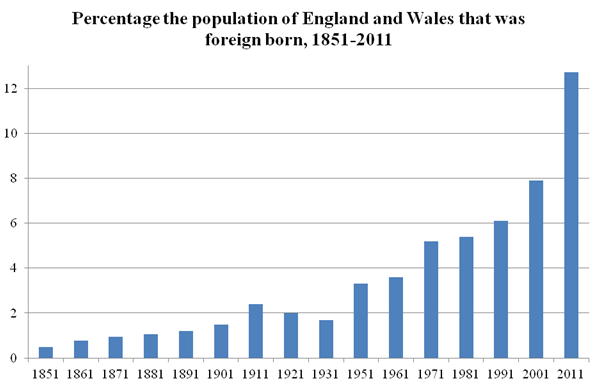
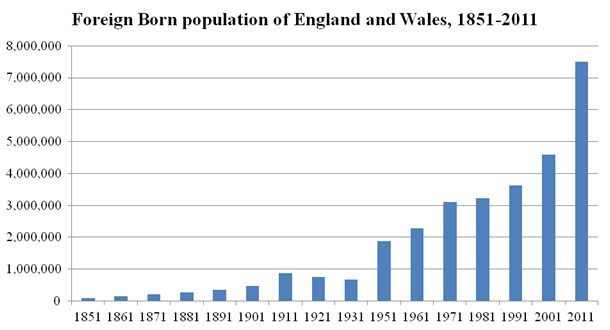
14.3. After the war, immigration increased, but this did not have a marked effect on the size of the foreign born population between the 1951 and 1961 census, with the number only increasing by about 225,000. The pace of change between the 1961 and 1971 censuses was quicker- increasing by almost a million in a decade. Between 1971 and 1981, the foreign born population only grew by about 100,000 and then by about 400,000 in the subsequent decade.
14.4. It was in the next decades that the pace and scale of immigration increased dramatically. Between 1991 and 2001 the foreign born population increased by about 1.1 million (with by far the highest levels of immigration taking place from 1997 onwards). It then increased by almost three million between 2001 and 2011. The change in the size of the foreign born population between 2001 and 2011 was absolutely without precedent in British history.
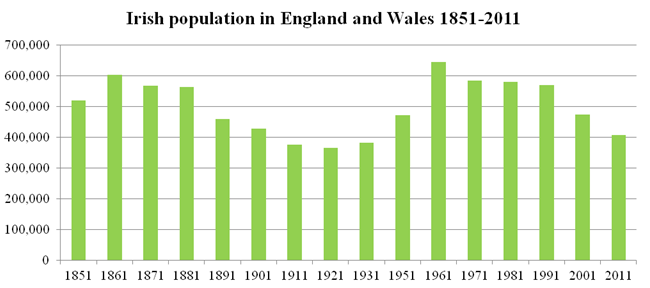
14.5. Table one shows the foreign born population of England and Wales, the total population, the Irish born population and the percentage of the population that was foreign born (excluding those born in Ireland up to and including the 1921 census, but not thereafter) at sucessive censuses between1851 and 2011.
| Year | Foreign born population | Total population | Irish born population | Percentage of total population that was born abroad |
| 1851 | 100,000 | 17,900,000 | 520,000 | 0.6 |
| 1861 | 150,000 | 20,100,000 | 600,000 | 0.7 |
| 1871 | 200,000 | 22,700,000 | 565,000 | 0.9 |
| 1881 | 275,000 | 26,000,000 | 560,00 | 1.1 |
| 1891 | 350,000 | 29,000,000 | 460,000 | 1.2 |
| 1901 | 475,000 | 32,500,000 | 425,000 | 1.5 |
| 1911 | 900,000 | 36,100,000 | 375,000 | 2.5 |
| 1921 | 750,000 | 37,900,000 | 365,000 | 2 |
| 1931 | 1,080,000 | 40,000,000 | 380,00 | 2.7 |
| 1951 | 1,875,000 | 43,700,000 | 470,000 | 4.3 |
| 1961 | 2,290,000 | 46,000,000 | 645,000 | 5.0 |
| 1971 | 3,100,000 | 48,700,000 | 585,000 | 6.4 |
| 1981 | 3,220,000 | 48,500,000 | 580,000 | 6.6 |
| 1991 | 3,625,000 | 49,900,000 | 570,000 | 7.3 |
| 2001 | 4,600,000 | 52, 500,000 | 475,000 | 8.8 |
| 2011 | 7,500,000 | 56,000,000 | 400,000 | 13.4 |
14.6. Figure two: The total number of foreign born people, 1851-2011.
15. Irish immigration
15.1. Irish immigration is a unique case- between 1801 and 1921 the whole of Ireland was part of the United Kingdom. None the less, census data shows that movements from Ireland to England and Wales (as well as Scotland, not covered in these figures) have historically been quite substantial.
15.2. Figure three: The population of England and Wales that was born in Ireland, 1851-2011.[62]
16. Conclusion
16.1. Britain has experienced many relatively small episodes of immigration over the centuries. For nearly a thousand years migration was on a very small scale compared to the size of the population. In the decades between the Second World War and the late 1990s, foreign immigration grew steadily at a relatively modest rate before declining in the late 1960s and becoming fairly stable between 1971 and 1981. The massive increase in the level of migration since the late 1990s is utterly unprecedented in the country’s history, dwarfing the scale of anything that went before.