A selection of recent media reports

Man raped two girls in Glasgow flats
A man from Afghanistan has been found guilty of raping two young girls at flats in Glasgow.
BBC News UK (03-Feb-2012)
Ten jailed over sham marriage plot
Published on Thursday 2 February 2012 18:01 Ten people have been jailed for attempting to organise an international sha...
Ilkeston Advertiser (03-Feb-2012)
IMMIGRATION CLAMPDOWN
IMMIGRANTS will only be allowed into Britain if they can \u201Cmake the country better\u201D.
Daily Star (03-Feb-2012)
Immigration: dubious means to an uncertain end
The truth is that politicians worry about immigration more than the rest of the population do, not less
Guardian.co.uk (02-Feb-2012)
Immigration is not just a numbers game \u2013 it's about culture, too
The debate about what constitutes Britishness has barely begun.
Telegraph.co.uk (02-Feb-2012)
A traitor's tale
Leaving the Labour party is uniquely traumatic, as Luke Bozier has just discovered \u2013 and I know all too well
The Spectator (02-Feb-2012)
Immigration minister wants more scrutiny of 'value' of foreign students
Expanding the number of international students in the UK is not necessarily a good t
Times Higher Education (02-Feb-2012)
Select migrants 'helped by reforms'
High-earning migrants and promising student entrepreneurs will find it easier to work in Britain as the Government aims ...
The Oxford Times (02-Feb-2012)
Damian Green: 'we only want the brightest immigrants'
The Immigration Minister says the Government will meet its target of reducing net migration into the U
Telegraph.co.uk (02-Feb-2012)
Human rights decisions led to 'ridiculous and damaging' situation, warns minister
The way courts interpret the human right to family life has led to a "ridiculo
Telegraph.co.uk (02-Feb-2012)
Immigration minister Damian Green on who can come to UK
Britain does not need more "middle managers" or unskilled Labour and those coming in should be able to command a
BBC News - UK Politics (02-Feb-2012)
Conservatives put politics before policy on immigration
Damian Green's speech on immigration was thin, and contained nothing new.
New Statesman (02-Feb-2012)
Migrants must be 'the right people'
Immigration policies must ensure "the right people are coming here", the Immigration Minister said. Damian Green said i
Belfast Telegraph (02-Feb-2012)
Migrants must add to quality of life in Britain \u2013 minister
Migrants must "add to the quality of life in Britain" if they want to live here, the Immigration Ministe
Telegraph.co.uk (02-Feb-2012)
Tougher migration rules
Immigrants must prove they will "add to the quality of life in Britain" before they're allowed into Britain, the Governm...
ITV.com (02-Feb-2012)
Immigration focus turns to 'quality'
Helen Warrell By Helen Warrell Britain does not need more immigrants who will be "middle managers" but should inst
Financial Times Print Edition (UK) (02-Feb-2012)
Immigrants 'must benefit Britain'
Immigrants must "add to the quality of life in Britain" to be let in, the immigration minister is to say.
London Evening Standard (02-Feb-2012)
UK Border Agency admit 57 of its own staff have committed immigration offences
THE UK Border Agency has been forced to admit 57 of its staff have been guilty of immi
Mirror.co.uk (02-Feb-2012)
New immigration policy favours the wealthy, say critics
Immigration minister to signal more selective policy under which only the right kind of migrants are all
Guardian.co.uk (02-Feb-2012)

Migration Trends 9.27

Population Growth – Migration or Birth rate?

Summary
1 No remotely credible fall in the birth rate will prevent the UK population reaching 70 million in 25 years at the latest. The only way to curb population below this level is to make a sharp cut in net immigration from the present level of 160,500 a year to about 40,000.

Introduction
2 The latest (2008-based) Office for National Statistics (ONS) population projections show the population of the UK reaching 70 million in 2029. Some suggest that such projections are unreliable because changes in the birth rate are unpredictable. (The technical term is the Total Fertility Rate (TFR) which is the average number of children that a woman would have if she experienced current fertility rates throughout her child bearing years).

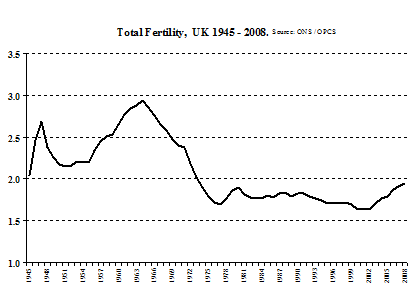
3 Apart from the “baby boom” when the TFR for the UK peaked at 2.95, the TFR has fluctuated between quite narrow limits since the mid 1970s as the following graph illustrates. Since 2001 it has been increasing, partly because of immigration.
Graph1

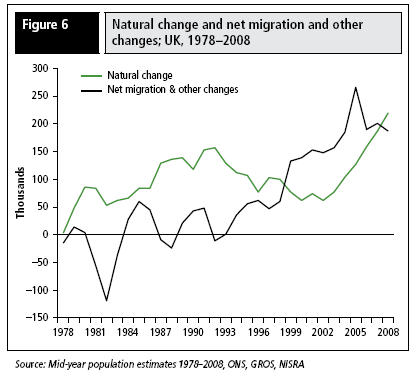
4 Since the TFR started to increase at the turn of the century both natural change (births minus deaths) and immigration have contributed substantially to population growth.

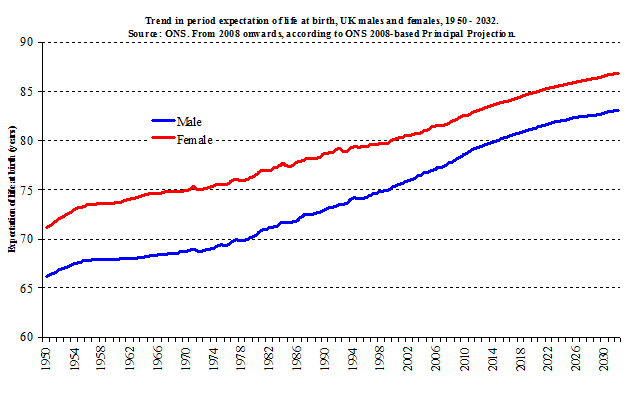
5 Life expectancy has increased fairly steadily over the past half century. It is therefore reasonable to project this forward as the ONS has done in their 2008 based principal projection as illustrated by the following graph.
Graph2

Graph3

6 As regards the future, the latest official population projections are based on an assumed TFR of 1.85 and net immigration of 180,000 a year.

7 To examine the effect of changes in the birth rate, the following graph holds the death rate and net immigration the same as the principal projection published by the ONS and varies the TFR.

Graph4

8 The present TFR for the UK is 1.96 but the principal projection took the more cautious assumption of 1.85. The lowest curve shows the effect of taking a TFR of 1.65 - the lowest it has ever been in the 20th and 21st century. It shows that, even at this level of births, the present rate of immigration will bring our population to 70 million in about 2033.

9 The recent increase in the birth rate appears to have been due mostly to increases in the birth rate of the UK-born population, although the birth rate is also sustained by the higher fertility of foreign-born women (who have a TFR of 2.49 compared to 1.84 for UK born women - 35% higher [1]). They contributed 24% of all births in England and Wales in 2008. If the TFR remained at the most recent published level, say 1.95, that would bring the UK population to 70 million in 2026.

10 It follows that even a fall in the birth rate to the lowest level experienced for over a century would, however unlikely, not prevent the population reaching 70 million in the next 25 years. The only way to do so would be by a severe cut in net immigration.

28 January, 2010

Notes

  1. Population Trends 138, page 11. Table 3.