Ten years ago this week, Britain voted to leave the European Union. For the millions who voted Leave, the meaning of “Take Back Control” was not complicated: bring the numbers down. Net migration had been above 300,000 a year for most of the previous decade. The government had promised to cut it to tens of thousands and had not come close. The referendum was the public’s verdict on that failure.
Ten years on, five Prime Ministers later, with more than 3.7 million in cumulative net migration, we have published a report asking whether that verdict was ever acted on. It was not.
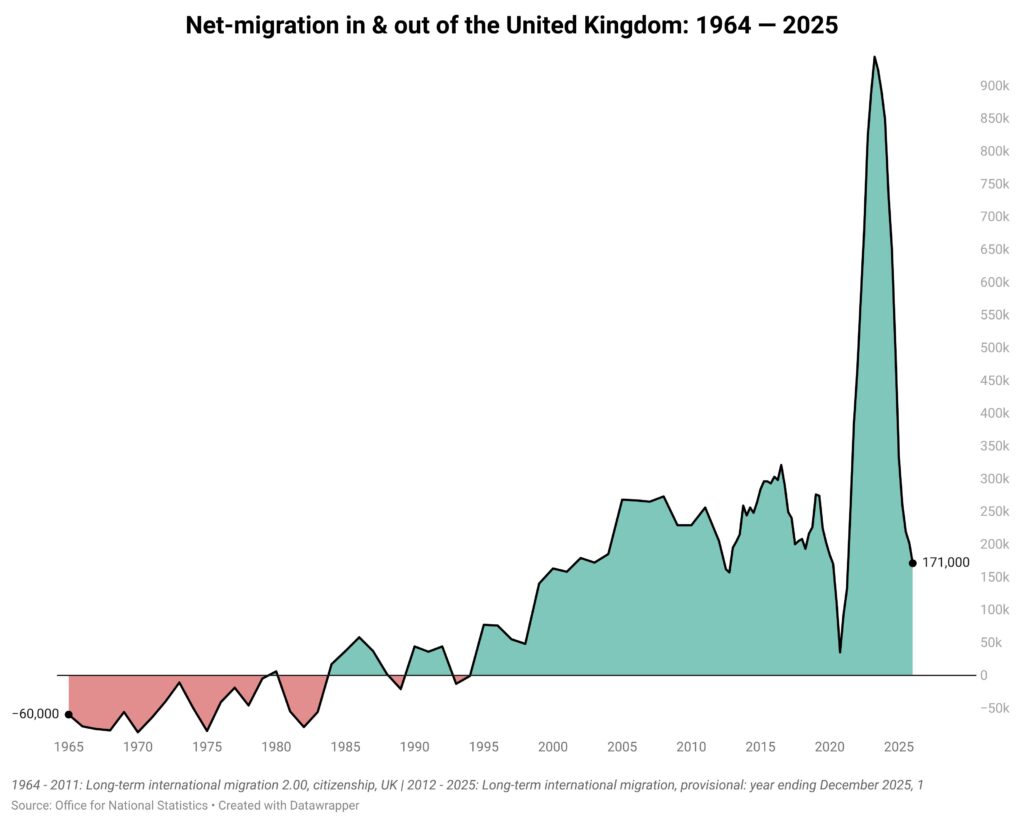
Net migration hit 745,000 in 2022. That is nearly eight times the upper limit of the tens of thousands pledge the Conservatives put in four consecutive manifestos. It is higher than anything ever recorded under EU free movement. This was not an accident or an unforeseen consequence. It was the direct result of choices made in 2021 by the government that had championed the Brexit mandate loudest.
Boris Johnson’s points-based system, introduced in January 2021, was more open than the one it replaced in every way that mattered. The skill threshold was cut from degree level to A-level. The requirement for employers to look for a British worker before hiring overseas was scrapped. The salary floor was lowered. And the one hard numerical limit in the system, the 20,700 annual cap on skilled worker certificates that had been in place since 2011 and had never once been breached, was removed entirely. Once the rules were met, the Home Office had no power to refuse. The numbers were set by whatever employers and universities chose to demand, and demand surged.
The Health and Care visa, created as a pandemic measure, was left open with no cap and no end date. The Graduate visa, which Theresa May had abolished in 2012 precisely because it kept students in the country beyond the purpose of their studies, was quietly brought back in 2021. Before it was reinstated, fewer than 20 per cent of international students moved onto another visa after finishing their degree. By 2022, 2023 and 2024 the figure was over half. Labour’s own 2025 Immigration White Paper described this as “widespread misuse”. The policy that caused it was introduced by the government that said it was taking back control.
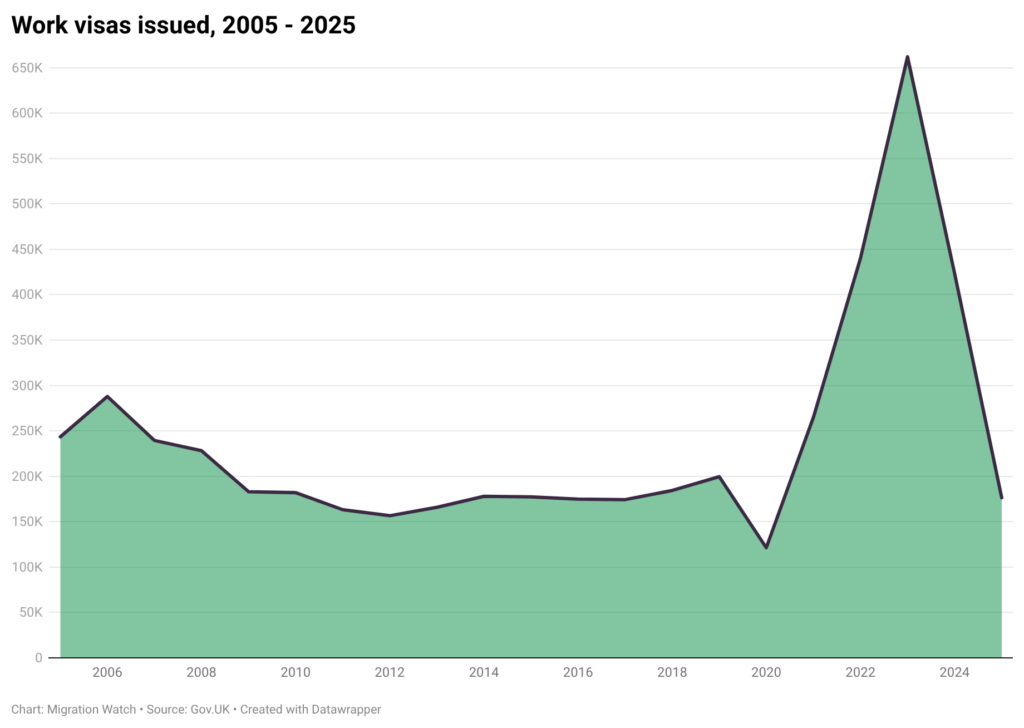
Rishi Sunak inherited the consequences and introduced real tightening measures: higher salary thresholds, restrictions on student and care worker dependants. Work visas fell from 613,000 in 2023 to 369,000 in 2024. But net migration was still 431,000 for the year to December 2024, four times the tens of thousands target.
The proof that a cap works is sitting in the recent past. The 20,700 limit on skilled worker visas ran from 2011 to 2021, was never breached, and helped push non-EU net migration to its lowest level since the 1990s. It worked because it was a fixed ceiling. When Johnson removed it, we warned that non-EU immigration would rise sharply as a result. It did.