Migration Watch UK

Submission to the House of Lords Select Committee on Economic Affairs on ‘The Economic Impact of Immigration’
23 September, 2007
Summary1. There are two central questions:
(a) What is the impact of immigration on our population and quality of life?
(b) Why do we need a higher population?
This paper suggests that the economic benefits of mass immigration are small while the social costs are high.
Number and characteristics of recent immigrants
2. Net immigration is a recent phenomenon as illustrated by the bar chart below:
Net International Migration into England 1964-2005
(Source: Parliamentary Written Answer WA91 - 17.10.2005 and
ONS International Migration Series MN32)
3. Immigration is highly concentrated in the South East, especially in London. The following table gives a regional breakdown of net international migration in the period 1993 - 2005 [1]:
|
Country/Region |
Net immigration 1993-2005 |
Percentage of total |
|
Scotland |
-10,000 |
-1% |
|
Northern Ireland |
-36,000 |
-2% |
|
Wales |
27,000 |
2% |
|
South-East |
144,000 |
9% |
|
London |
1,035,000 |
65% |
|
Rest of England |
437,000 |
27% |
4. The Government Actuary Department's assumptions of net international migration, used in their population projections, have consistently been understated. They now assume that net immigration will fall by about 30% and then stay flat at 145,000 a year. The following graph shows how they have progressively raised their assumption since 1996:
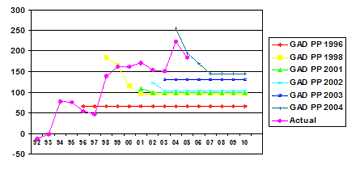
5. Based on these projections, international migration will add nearly 6 million to the UK's population in the period 2004-2031 out of a total population increase of 7.2 million [2]. (So migration will contribute 83% of the population increase):
6. The source of net foreign migration in 2004 and 2005 combined was as follows:
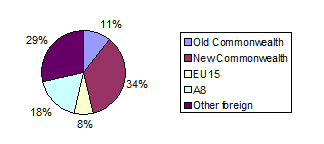
(Source: ONS International Migration - Series MN32 table 2.1a)
7. Migration flows from the 'old' EU are relatively small at 8% while Eastern Europe accounts for less than one fifth of foreign immigration (but see para 8 below). Nearly two-thirds of net foreign immigration into the UK is from New Commonwealth or 'Other Foreign' countries, mainly developing countries. Migrants from the developing world are far more likely to settle in the UK while the flow of migrants from the A8 countries is likely to get back into balance once these countries' economies 'catch up' with the UK.
8. It may well be that A8 migrants are understated by the International Passenger Survey. Many use the smaller ports of entry which are given insufficient coverage in the IPS and the survey asks about intentions which may well change. It may be significant that, in the year from mid-2005 to mid-2006, net migration from the A8 countries was recorded as just 58,000 but in the same period 210,000 East Europeans registered to work in the UK [3]. Self-employed workers and dependants of all workers are additional to this figure. Recent survey evidence suggests that only 45% of Polish migrants expected to return to Poland within 4 years.
Economic impact of migrants
Impact on GDP
9. Various claims have been made by the government about the impact of migration on GDP, for example:
1. Migrants make up 8% of the population but contribute 10% to GDP [4].
2. Migrants make up 8% of the working population but contribute 10% to GDP [5].
3. Migrants add 15% to 20% to trend growth.
10. The first claim took no account of the fact that the majority of migrants are young and their children are mainly UK-born and are not counted in the migrant population. When UK-born children are taken into account migrants add roughly the same to the GDP as they add to population so that there is no increase in GDP per head.
11. The second claim takes no account of the lower employment rate of migrants. When this is taken into account their addition to the working age population is roughly 10% or about the same as their addition to GDP.
12. The third claim is based on a Treasury assumption that immigrants add to production in the same proportion that they add to the size of the work force. This gives an addition of 15 - 20 % to trend growth which, in turn is now assessed as 2.75%. As a matter of arithmetic, that works out at an annual benefit to the native population of about £14 per year or 28 pence a week. (See Annex A for details).
13. Thus, using the Treasury's own assumptions, the average addition to GDP per head is very small indeed. In contrast the impact on population is very large - equivalent to a new Birmingham every five years.
14. This result is in line with studies in the USA, Canada and The Netherlands. Each found that the impact of immigration on GDP per head was small. For instance, the Netherlands Bureau for Economic Policy Analysis, part of the Ministry for Economic Affairs, carried out a study which concluded that: 'the overall net gain in income of residents is likely to be small and may even be negative'. [6]
Fiscal impact
15. Studies by the Home Office[7] and by the Institute for Public Policy Research (IPPR)[8] purported to show that:
• Migrants contributed £2.5 billion more in taxes and national insurance contributions in 1999/2000 than they received in benefits and public services.
• Migrants' net contribution (in taxes and NI contributions compared to benefits and services received) was relatively higher than the UK-born population.
16. The first claim considered a year when the public finances were in surplus so that both migrants and the UK-born made positive fiscal contributions.
17. The second claim turned on the treatment of UK-born children of migrants. The costs of children were allocated according to the birthplace of their parents but the costs of children of mixed parentage were all allocated to the UK-born population. Correcting for this (i.e. allocating the costs of these children equally to the UK-born and foreign-born population) resulted in:
• The £2.5 billion 'surplus' being changed into a deficit of about £100 million.
• The migrant population making a smaller net contribution per head than the UK-born in 1999/2000 and a similar contribution in 2003/4.
Overall therefore there is no fiscal benefit to the host population.
Impact on infrastructure
18. Clearly the large growth in population resulting from migration will require an expansion of infrastructure, for example in transport and utility supplies. The most obvious impact, however, has been (and will be) on housing.
19. In the period 1997-2005 the number of households in England is estimated to have increased by 1.563 million of which 592,000 (37.9%) are migrant households[9] . Over the same period the housing stock has risen by 1.336 million. The rise in housing stock has therefore failed to keep up with the number of households formed - the shortage is nearly a quarter of a million homes. With net migration at half the levels experienced between 1997 and 2005 there would have been no shortfall between supply and demand - this shortfall accounted for much of the surge in house prices experienced in the period.
20. Household projections issued by the Department for Communities and Local Government now project an annual growth in households of 223,000 a year of which one third (73,000 a year) are attributable to the assumed rate of net migration (see paragraph 4 above).
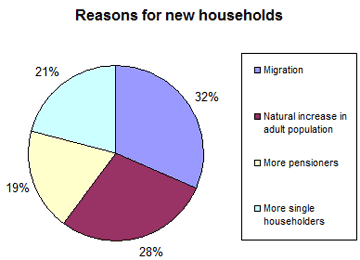
21. Immigration is therefore a major component of the need to expand the house building programme and to expand onto greenfield sites. It is also important to note that new households formed by more people living alone and more people of pensioner age do not add to population density so there will be little need for additional infrastructure (shops, workplaces, transport etc.). Among the native population, the number of additional adults will increase by less than 3 million (6%) between 2004 and 2031.
Conclusion
22. We conclude that the overall economic benefits of immigration in terms of GDP per head and fiscal impact are largely neutral. Annex A
The impact of immigration on GDP per head
1. In their 2006 pre-budget report, the Treasury estimated that immigration in the period 2001Q3 to end 2005 had added about ½ per cent a year to the working age population. They assumed that migrants contributed the same %age to GDP growth as they added to population. Trend growth is now estimated to be 2.75% a year. ½ per cent of this is 18.2% - hence the government claim that migrants add 15 - 20 % to trend growth.
2. However, this takes no account of the addition to overall population and hence the impact on GDP per head. Using GAD population projections and the Treasury assumptions the following would be the impact of migration on GDP per head at today's production levels:
a) Annual growth in working age population due to migration from 2004-2031 = 0.42%.
b) Thus, annual growth in GDP due to migration in this period = 0.42%.
c) Annual growth in the overall population from 2004-2031 due to net migration = 0.35%.
d) Average annual addition to GDP per head of population (b-c) due to net migration = 0.07%.
e) Addition to GDP per head each year (at 2005 production levels) [10] = £14 p.a. or 28p a week.
Footnotes
- ONS International Migration – Series MN
- GAD Web article on migration and population growth
- Source Home Office: Accession Monitoring Report
- Home Office Press Release 12.11.2003
- Parliamentary answer given by Ruth Kelly, then Financial Secretary to the Treasury, in May 2002
- Migrationwatch Briefing Paper 'Immigration & the Dutch Economy'
- Show -6 more...
- ONS International Migration – Series MN
- GAD Web article on migration and population growth
- Source Home Office: Accession Monitoring Report
- Home Office Press Release 12.11.2003
- Parliamentary answer given by Ruth Kelly, then Financial Secretary to the Treasury, in May 2002
- Migrationwatch Briefing Paper 'Immigration & the Dutch Economy'
- The migrant population in the UK:fiscal effects - Home Office: Ceri Gott and Karl Johnston
- IPPR: The fiscal contribution of migrants in the UK: Danny Sriskandarajah, Lawrence Colley and Howard Reed
- House of Commons Library ref 2007/7/69 - SGS
- Based on GDP of £1,234 billion in 2005 (Source:ONS) and a UK population of 60 million.