Migration Watch UK

15 January, 2004
Summary1. The Home Secretary has recently cited Scotland , with its skills gaps and ageing population, as a reason why the United Kingdom needs large-scale inwards migration. But it is unclear why a low birth rate and loss of population in a relatively small part of the United Kingdom with only 8.5% of its population should prove the need for heavy immigration into the UK , which overall has a very dense and growing population.
2. The United Kingdom has had very high levels of net migration over recent years (875,000 [1] in the last 10 years) but over the same period Scotland has had a net loss of 41,000 by emigration. This shows that heavy immigration into the UK does not prevent a loss of population from Scotland .
3. International migrants have been mainly attracted to London and the South East but there has been a partially compensating movement of people to the English regions and to Wales .
In contrast Scotland has had a small outflow of people to the rest of the United Kingdom in recent years.
4. Scotland also has a very low Total Fertility Rate (TFR) of 1.48 in contrast with the UK as a whole of 1.65 and this is naturally giving cause for some longer-term concern. But this should not be exaggerated. On present projections, Scotland 's population will decline by only about 10% over the next 40 years.
5. However, migration is unlikely to prove a solution to these problems - the scale of the migration required would be both substantial and prolonged and immigration on this scale would be likely to cause social problems.
6. More promising solutions to population ageing would be to try to stimulate the economy and create more and better jobs so as to stem net emigration and to seek to raise the birth rate through family friendly policies, like those adopted in Scandinavia .
Detail
7. As part of his justification for continued high levels of migration into the UK , the Home Secretary recently cited Scotland 's need for migrants to fill vacancies in the economy.
8. The Home Secretary's remarks followed data showing that births in Scotland were at a record low. Scotland has a birth rate, 10.4 per 1000, and Total Fertility Rate, 1.49 children per woman, both slightly lower than the UK as a whole, which has rates of 11.4 per 1000 and 1.65 children per woman. Its lower rates will lead to slightly faster population ageing than in the rest of the UK , and to a slow, small population loss, projected to fall from 5,064,000 in 2001 to 4,770,000 in 2031. Whilst it will be necessary to adapt to population ageing, there are reasons to believe that the slow fall in population will be beneficial.
9. There are good reasons to think that the low birth rate in Scotland is due to the net emigration of young people who, early in their reproductive life, move to England and elsewhere to obtain better jobs than are available in Scotland . During the past centuries many young people and their progeny have been lost to Scotland in this way. The net annual emigration in the ten year periods between the 1901 and 1991 censuses have varied from 10,000 to 39,000, averaging 21,000. If that is the explanation for the present low birth rate, it should be concluded that Scotland needs more jobs, not more workers.
10. An indication that net migration from Scotland is due to a scarcity of suitable jobs is that Scotland has a significantly higher rate of unemployment (6.8% in 2002) than the UK as a whole (5.2%). In 2001 its claims for unemployment benefit were 4.2% of its workforce, whilst those in the UK as a whole were only 3.2%.
11. Scotland 's share of the UK 's inward international migration in the period 1992-2001 has been just 4.7%. Over the same period its share of outward international migration has been 7.7% [2]. Scotland 's population in comparison is about 8.5% of the UK 's. The result has been that there has been net international emigration from Scotland over that period of 41,100 in contrast to net international migration into the UK as a whole of 875,000. The year by year net migration figures are shown below, together with the UK figures for comparison.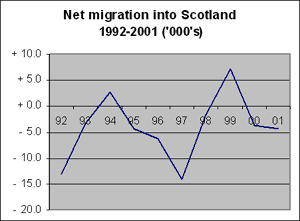
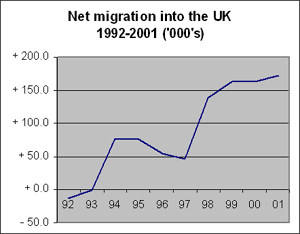
12. The conclusion here is clear that Scotland is just not attracting international migrants - in fact there is a small but significant net outflow of people abroad.
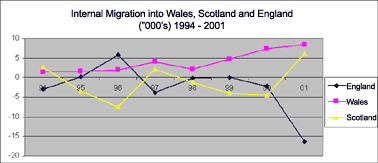
13. In fact the flow of international migrants is mainly into London and the South-East which attracted over 75% of net migrants in the 1992-2001 timescale. These flows of people have, however, been partially offset by internal migration in England from London and the South-East to the regions. There has also been an overall flow of people to Wales but, in contrast, with the exception of 2001, Scotland has generally had a net loss of people to the rest of the UK as demonstrated by the following graph [3]:
Source: ONS: Internal Migration Statistics
14. Scotland 's population at June 2002 was 5,055,000 a fall of 9,400 on the previous year. Births in 2002 were at an all time low of 51,270. [4]
15. The population has been about 5 million for 50 years - but until recently there was an excess of births over deaths which was balanced by out migration. For the last four years deaths have exceeded births (by 7,000 in 2002) and as a result the population is expected to dip below 5 million in 10 years. Over the next 40 years it will decline by about 10%. The key issue here is that Scotland has a very low birth rate - 1.48 in comparison with the average for the UK as a whole of 1.65.
16. Migration is not a solution to these problems - as Hamish McRae wrote in the Sunday Independent (referring to Europe 's demographic problems generally) "that [immigration] does not help as much as one might expect, partly because of skills gaps and partly because the scale of immigration needed would create social problems" [5].
17. Scotland has been badly hit recently by the contraction in manufacturing employment. 'Silicon Glen' the advanced technology manufacturing sector in the Glasgow-Edinburgh corridor is reported to have shed a third of its employees with the loss of tens of thousands of jobs. Also Scotland 's share of international investment into the UK has fallen from 20% in the 1990's to 7% now [6]. Arguably, it is a vibrant economy which attracts migrants (and reduces out migration) rather than the other way round.
18. The creation of more jobs is difficult because manufacturing in the UK is declining under a burden of labour costs, taxation and regulations much heavier than those of competing manufacturers in Eastern Europe and Asia . Indeed many UK manufacturers are moving work and jobs to the cheaper countries. The effect is seen in the UK 's large and growing deficit in its balance of trade in manufactured goods, which was £26bn. in 2001. Scottish industries are further burdened by the costs of transport to their main markets in the south and longer distances from their main suppliers of material, components and supporting services. Also by slighter higher local authority rates.
19. More sustainable solutions to Scotland 's demographic problems are therefore likely to lie in:
• creating a dynamic economy which will, at the very least, stem the outflow of people to international destinations and which would attract migration from the rest of the United Kingdom; and
• Taking friendly family actions which would raise the birth rate. Such actions have been successful in Scandinavia, which in contrast to the rest of Europe , still enjoys birth rates which are at or near natural replacement levels.
| [1] | Total International Migration - Time Series 1992-2001 Office for National Statistics |
| [2] | Total International Migration - Time Series 1992-2001 Office for National Statistics |
| [3] | Source: ONS: Internal Migration Statistics |
| [4] | Source : Scottish Executive web-site |
| [5] | Economic View - Sunday Independent 30 November. |
| [6] | Source: BBC on line 29/10/2003 |